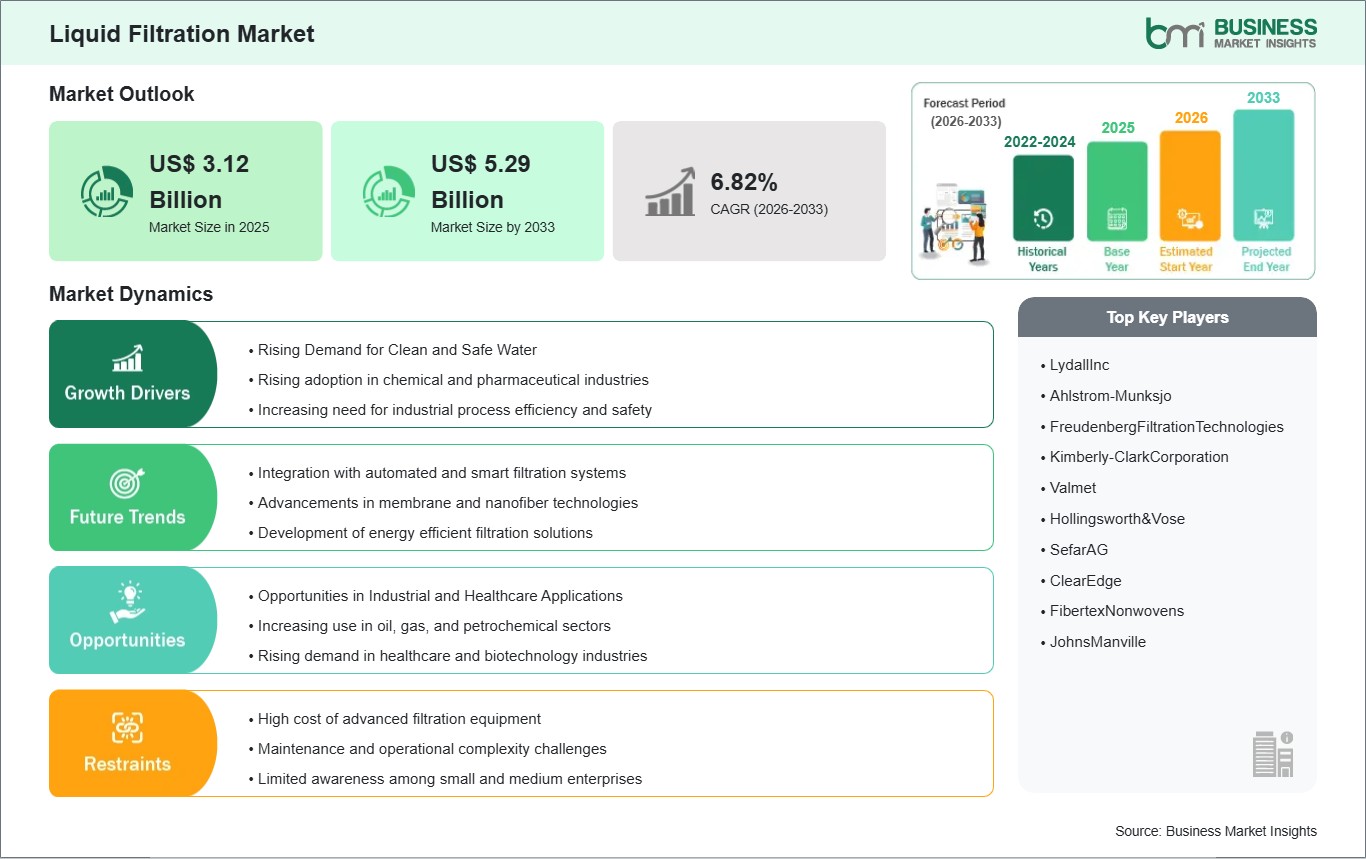
The Liquid Filtration Industry is experiencing a period of significant expansion and technological refinement, establishing itself as a critical pillar for environmental sustainability, public health, and industrial efficiency.
According to Business Market Insights, the global Liquid Filtration Market size is expected to reach US$ 5.29 Billion by 2033 from US$ 3.12 Billion in 2025. The market is estimated to record a CAGR of 6.82% from 2026 to 2033.
Recent breakthroughs in advanced membrane chemistries, smart automated self-cleaning configurations, and nanofiber integration are radically extending filter life cycles while dropping energy consumption. Process engineering firms and manufacturing plants are aggressively deploying these next-generation filtration assets to meet zero-liquid-discharge (ZLD) mandates, optimize resource recovery, and safeguard downstream equipment from premature fouling and chemical degradation.
Download Sample Report : https://www.businessmarketinsights.com/sample/BMIPUB00034012
What Is Liquid Filtration?
Liquid filtration is the mechanical, physical, or biological process of separating solid suspended particles, contaminants, and impurities from a liquid carrier by passing it through a porous medium. The medium retains the solid matter while allowing the clarified fluid, known as the filtrate, to pass through. This process spans across varying levels of precision, categorized widely as macro-filtration, micro-filtration, ultra-filtration, and reverse osmosis (RO) depending on the particle size being targeted.
A complete modern liquid filtration assembly integrates custom-engineered housings, pressure monitoring arrays, and specialized filter media such as woven fabrics, non-woven membranes, cartridge elements, or granular beds. By utilizing precise pore geometries and surface charges, these systems reliably remove everything from coarse sand and rust particles to sub-micron bacteria, heavy metals, and emulsified oils under highly variable industrial flow rates and pressures.
Market Drivers
The primary driver propelling the Liquid Filtration Market is the stringent execution of environmental protection laws and clean water mandates worldwide. Governments are imposing heavy financial penalties on industrial operations that fail to properly treat effluent before discharge. This regulatory push forces sectors like chemicals, mining, and metal processing to adopt comprehensive, multi-tiered liquid filtration frameworks to clean their process water and maximize internal recycling loops.
Furthermore, the soaring global demand for municipal drinking water purification acts as a massive growth catalyst. Rapid urbanization and dwindling fresh water reserves are compelling cities to expand their water treatment infrastructures. Advanced filtration media, including ultrafiltration and reverse osmosis membranes, are essential for desalinating seawater and turning heavily contaminated surface water into safe, potable drinking water for millions of citizens.
Additionally, the rapid expansion of the pharmaceutical, biotechnology, and food and beverage sectors is accelerating volume demand. These industries require absolute purity to maintain product safety and satisfy regulatory agencies like the FDA. Liquid filtration systems eliminate any possibility of microbial contamination, ensure sterile ingredient processing, and purify active pharmaceutical ingredients (APIs) during delicate batch synthesis procedures.
Get More Details : https://www.businessmarketinsights.com/buy/BMIPUB00034012
Market Segmentation
By Filter Media Type
- Woven Fabrics
- Non-Woven Fabrics
- Mesh/Wire Cloth
- Membranes (Polymeric, Ceramic)
- Sintered Metal & Porous Plastics
By Fabric Material
- Polymer (Polypropylene, Polyester, Nylon)
- Natural Fibers (Cotton)
- Inorganic / Glass Fibers
By End-User Industry
- Water & Wastewater Treatment
- Food & Beverages
- Pharmaceuticals & Biotechnology
- Chemicals & Petrochemicals
- Power Generation
- Mining & Metals
The non-woven fabrics and membrane segments account for the lion’s share of global market revenue due to their exceptional filtration efficiency and widespread utilization across municipal water hubs and micro-electronics cleaning lines. From an end-user perspective, the water and wastewater treatment vertical remains the dominant volume purchaser, while the pharmaceutical and biotechnology segment represents a premium, high-velocity growth pocket demanding specialized, ultra-pure filtration media.
Regional Insights
- Asia-Pacific represents the largest and most dynamic regional market for liquid filtration globally. This dominance is driven by rapid industrialization, massive investments in state-managed municipal water networks, and aggressive environmental cleanup campaigns across China, India, and Southeast Asia.
- North America holds a highly mature and high-value market position, heavily anchored by widespread corporate spending on water recycling technologies, intensive pharmaceutical R&D manufacturing, and strict EPA clean water standards across the United States.
- Europe commands a powerful market share, strongly defined by the region’s pioneering stance on zero-liquid-discharge (ZLD) industrial operations, strict European Union environmental mandates, and a dense network of high-end chemical and food processing plants in Germany and France.
- Middle East & Africa and South & Central America are demonstrating steady, strategic progress, heavily supported by substantial investments in massive desalination plants and expanding mining infrastructures requiring industrial-scale slurry separation.
Top Players in the Liquid Filtration Industry
The global marketplace features concentrated competition among diversified industrial conglomerates, specialized membrane engineers, and broad environmental fluid management corporations. Key market participants place heavy emphasis on designing bio-based sustainable filter media, developing anti-fouling coatings, and offering modular plug-and-play field units.
- Alfa Laval AB
- Danaher Corporation (Pall Corporation)
- Eaton Corporation plc
- Donaldson Company, Inc.
- 3M Company
- Parker-Hannifin Corporation
- Freudenberg Filtration Technologies SE & Co. KG
- The Mann+Hummel Group
- Pentair plc
- Suez Water Technologies & Solutions (Veolia)
These market leaders consistently expand their regional footprints by acquiring boutique filtration engineering firms and working alongside civil engineering contractors to secure long-term municipal water infrastructure supply deals.
Technological Innovations
Technological innovations in Nanofiber Filter Media are fundamentally upgrading industrial separation limits. Traditional polymer filters can restrict fluid flow if the pores are too small, driving up pump electricity costs. By electrospinning nanofibers onto traditional backings, engineers create media with incredibly high porosity and surface area. This allows the system to trap sub-micron particles with minimal resistance, dramatically reducing pressure drops and cutting plant operational expenses.
Furthermore, the integration of IoT-enabled Smart Filters is revolutionizing system maintenance. Next-generation filtration housings are fitted with wireless differential pressure sensors and acoustic emission monitors. These sensors track the exact rate of particulate accumulation and membrane fouling in real-time. Instead of replacing expensive filter cartridges on a rigid schedule, maintenance teams can wait until maximum loading is safely achieved, eliminating premature filter disposal and reducing downtime.
Additionally, advancements in Ceramic Membrane technology are opening entirely new application frontiers. Traditional polymeric membranes degrade quickly when exposed to aggressive organic solvents, extreme pH levels, or high-temperature steam sterilization cycles. Ceramic filters made from alumina or silicon carbide are virtually indestructible under these harsh conditions, allowing petrochemical facilities and heavy industrial processors to safely filter volatile chemical streams that would immediately dissolve standard plastics.
Future Market Outlook
The long-term trajectory for the Liquid Filtration Market remains exceptionally strong and highly critical. As global freshwater scarcity intensifies and the true economic cost of drawing clean water increases, industrial facilities will be forced to transition to closed-loop water ecosystems where every gallon of process fluid is filtered, cleaned, and continuously reused inside the facility.
The upcoming maturation of bio-based, biodegradable filter materials will align the industry with global circular economy objectives. Future filter cartridges will utilize sustainable natural cellulose composites and biopolymers that offer identical capture efficiencies as petrochemical plastics but can be cleanly composted or recycled after use. Companies that master low-energy membrane designs, deliver durable high-temperature ceramic modules, and minimize disposal waste will secure a commanding position in the global resource conservation landscape.
Frequently Asked Questions (FAQs)
What is the difference between microfiltration and ultrafiltration?
The main difference lies in the pore size of the filter membrane. Microfiltration typically utilizes membranes with pore sizes ranging from 0.1 to 10 microns, which are highly effective for removing suspended solids, large bacteria, and visible sediment. Ultrafiltration operates at a much finer scale, with pore sizes typically ranging from 0.01 to 0.1 microns, allowing it to successfully filter out viruses, macro-molecules, proteins, and fine colloidal silica that easily pass through microfiltration units.
What is a differential pressure drop, and why is it important in liquid filtration?
Differential pressure is the difference in fluid pressure between the inlet (dirty side) and the outlet (clean side) of a filter. As the filter media successfully captures contaminants, its pores become restricted, causing the inlet pressure to rise. Monitoring this pressure drop is essential; an elevated drop indicates the filter is fully loaded and must be cleaned or replaced to prevent fluid bypass, pump strain, or structural collapse of the media.
Can liquid filtration systems handle highly acidic or alkaline fluids?
Yes, but it requires selecting chemically compatible materials. While standard polypropylene or cotton filters can break down when exposed to harsh chemicals, industrial systems designed for aggressive fluids utilize specialized fluoropolymers (like PTFE) or robust ceramic membranes. These materials resist chemical degradation, ensuring consistent separation performance without leaching impurities back into the process stream.
How does automated self-cleaning filtration work?
Automated self-cleaning systems eliminate manual filter swaps. When onboard sensors detect that the differential pressure has reached a pre-set threshold, the system automatically triggers an internal cleaning cycle. This typically involves a mechanical scraper removing surface debris from a rigid screen or a brief, high-pressure backwash fluid pulse sent in the reverse direction, flushing accumulated contaminants out through a purge valve while the main system continues to run.
Browse More Reports:
https://www.businessmarketinsights.com/reports/newborn-screening-market
https://www.businessmarketinsights.com/reports/operational-technology-market
https://www.businessmarketinsights.com/reports/optical-satellite-market
About Us
Business Market Insights is a market research platform that provides a subscription service for industry and company reports. Our research team has extensive professional expertise in domains such as Electronics & Semiconductor; Aerospace & Defense; Automotive & Transportation; Energy & Power; Healthcare; Manufacturing & Construction; Food & Beverages; Chemicals & Materials; and Technology, Media, & Telecommunications.
Contact Us
If you have any questions about this report or would like further information, please contact us:
Contact person: Ankit Mathur
Email: sales@businessmarketinsights.com
Phone: +16467917070″