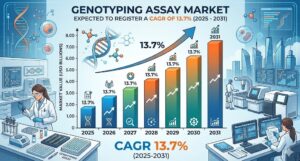
The Genotyping Assay Market is gaining substantial traction as the demand for accurate genetic analysis continues to rise across healthcare, biotechnology, and agricultural sectors. With a projected CAGR of 13.7% from 2025 to 2031, the market reflects a steady upward trajectory supported by technological advancements and growing awareness of genetic testing. Genotyping assays play a crucial role in identifying genetic variations, enabling early diagnosis of diseases, supporting drug development, and enhancing research capabilities. As the global focus shifts toward precision medicine and data driven healthcare, the adoption of genotyping solutions is accelerating at a significant pace.
Increasing Role of Personalized Medicine in Market Growth
One of the primary drivers of the genotyping assay market is the expanding adoption of personalized medicine. Healthcare systems worldwide are moving away from traditional treatment approaches and embracing therapies tailored to individual genetic profiles. Genotyping assays help identify how patients respond to specific drugs, allowing healthcare providers to design targeted treatment strategies that improve outcomes and reduce side effects. This shift toward individualized care is not only improving patient satisfaction but also optimizing healthcare costs by minimizing ineffective treatments.
Download Sample PDF @ https://www.theinsightpartners.com/sample/TIPRE00026505
The rising prevalence of chronic diseases and genetic disorders has further amplified the importance of genotyping assays. Early detection and prevention strategies are becoming a priority, particularly in developed regions where healthcare infrastructure supports advanced diagnostic solutions. As a result, the demand for genotyping assays in clinical settings continues to grow, reinforcing the overall expansion of the market.
Technological Advancements Driving Innovation
Technological progress remains a cornerstone of growth in the genotyping assay market. Innovations in sequencing technologies, particularly next generation sequencing, have significantly enhanced the speed, accuracy, and efficiency of genetic analysis. These advancements enable high throughput processing of genetic samples, making it possible to conduct large scale studies and obtain rapid results.
Polymerase chain reaction continues to be widely used due to its reliability and cost effectiveness, while other technologies such as microarrays, capillary electrophoresis, and mass spectrometry contribute to diverse applications. The integration of bioinformatics tools has further strengthened the analytical capabilities of genotyping assays, allowing researchers to interpret complex genetic data with greater precision.
Automation is also transforming laboratory workflows by reducing manual intervention and minimizing errors. Automated systems improve efficiency and scalability, enabling laboratories to handle increasing volumes of genetic tests. As technology continues to evolve, the cost of genotyping assays is expected to decrease, making these solutions more accessible to a broader range of users.
Get Full Copy of This Report @ https://www.theinsightpartners.com/buy/TIPRE00026505
Expanding Applications Across Multiple Industries
The versatility of genotyping assays is evident in their wide range of applications across different industries. In healthcare, they are extensively used in diagnostics, pharmacogenomics, and personalized medicine. These applications support early disease detection, enable targeted therapies, and improve patient outcomes.
In agricultural biotechnology, genotyping assays play a critical role in crop improvement and sustainability. They help identify desirable genetic traits, enhance resistance to pests and diseases, and increase crop yield. As global food demand continues to rise, the importance of these applications is becoming increasingly evident.
Animal genetics is another area where genotyping assays are making a significant impact. They are used in breeding programs to improve livestock quality and manage genetic disorders. Additionally, research institutions and academic organizations rely on genotyping assays for a wide range of studies, further contributing to market growth.
Emerging Markets Creating New Opportunities
Emerging economies are becoming key growth engines for the genotyping assay market. Regions such as Asia Pacific, Latin America, and the Middle East are witnessing increased adoption of genetic testing technologies due to improvements in healthcare infrastructure and rising awareness. Governments and private organizations in these regions are investing in biotechnology and genomics research, creating favorable conditions for market expansion.
The growing popularity of point of care testing is also opening new opportunities. Genotyping assays are increasingly being used in outpatient settings and even at home, providing quick and convenient results. This trend is particularly beneficial in remote or underserved areas where access to advanced laboratory facilities is limited.
Furthermore, the expansion of research activities in developing countries is driving demand for cost effective and scalable genotyping solutions. Market players are focusing on these regions to establish a strong presence and capitalize on untapped potential.
Competitive Landscape and Strategic Developments
The genotyping assay market is highly competitive, with several leading companies striving to strengthen their market position through innovation and strategic initiatives. Organizations are investing heavily in research and development to introduce advanced products that meet evolving customer needs. Collaborations, partnerships, and acquisitions are common strategies used to expand capabilities and enhance market reach.
Companies are also focusing on developing integrated solutions that combine instruments, reagents, and software to provide seamless workflows. This approach not only improves efficiency but also enhances customer satisfaction. As competition intensifies, the emphasis on quality, reliability, and cost effectiveness is becoming increasingly important.
Key Players:
- Illumina, Inc.
- Thermo Fisher Scientific, Inc.
- F. Hoffmann La Roche Ltd
- QIAGEN
- Danaher
- Agilent Technologies, Inc.
- Fluidigm Corporation
- General Electric Company
- Genewiz, Inc.
- Bio Rad Laboratories, Inc.
Future Outlook
The future of the genotyping assay market appears highly promising, driven by continuous advancements in genomic technologies and expanding application areas. As the demand for precise and rapid genetic insights continues to grow, genotyping assays are expected to become an integral part of routine healthcare and research practices. The integration of artificial intelligence and advanced analytics will further enhance data interpretation, enabling deeper insights and more informed decision making.
In addition, increasing collaboration between industry players, research institutions, and healthcare providers is expected to accelerate innovation and improve accessibility. The ongoing expansion into emerging markets and the development of cost effective solutions will further support market growth.
Related Reports @
Blue Biotechnology Market Size, Growth & Trends by 2034
Sickle Cell Anemia Testing And Screening Market Size, Trends & Demand by 2034
About Us –
The Insight Partners provides comprehensive syndicated and tailored market research services in the healthcare, technology, and industrial domains. Renowned for delivering strategic intelligence and practical insights, the firm empowers businesses to remain competitive in ever-evolving global markets.
Contact Us:
Ankit Mathur | The Insight Partners
E-mail: ankit.mathur@theinsightpartners.com
Phone: +1-646-491-9876
Also Available in : Korean| German| Japanese| French| Chinese| Italian| Spanish