The Urology Devices Industry is undergoing an intensive technological expansion globally, propelled by rising disease awareness, earlier diagnosis capabilities, increasing accessibility to urologic care, and a profound clinical shift toward ambulatory-care centers and outpatient settings that facilitate quicker patient recovery.
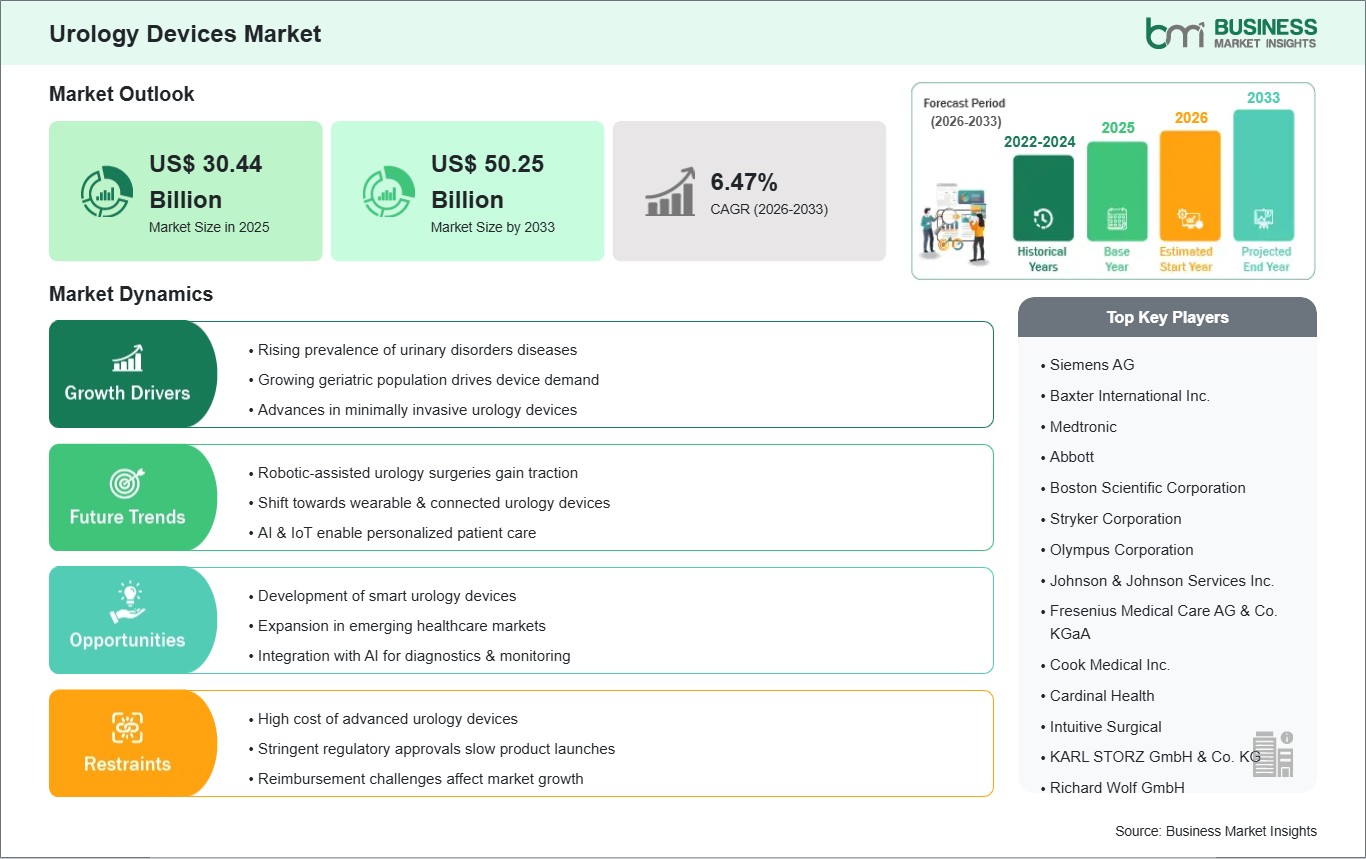
According to Business Market Insights, the global Urology Devices Market Size is expected to reach US$ 85.55 Billion by 2033 from US$ 51.25 Billion in 2025. The market is estimated to record a CAGR of 6.61% from 2026 to 2033.
The latest advancements in the field cover the introduction of single-use devices that inherently lower the risk of infection, the application of high-skilled imaging equipment that provides clear, real-time visuals for diagnosis, and the execution of laser treatments that unerringly target and pound stones. These modifications are playing a key role in the improvement of patient health outcomes and are driving the rapid adoption of minimally invasive and robotic surgical systems.
Modern urology heavily relies on these devices to perform an array of critical procedures. Instruments like endoscopes and lasers are deployed for breaking down renal stones (lithotripsy), excising tumors, and managing benign prostatic hyperplasia (BPH). As the clinical landscape evolves, the market is actively integrating advanced AI-enabled navigation and patient-specific 3-D printed implants, allowing clinicians to execute intricate urological surgeries with unprecedented precision and minimal tissue trauma.
Download Sample Report:https://www.businessmarketinsights.com/sample/BMIPUB00032507
Market Drivers
A primary driver for the Urology Devices Industry is the widespread transition toward Minimally Invasive Surgery (MIS) Devices. Doctors are increasingly opting for less invasive procedures because they present fewer operational risks, drastically reduce inpatient hospital stays, and ensure improved patient recovery across all major urologic conditions. This clinical preference has established minimally invasive instruments as the dominating technological segment globally.
Furthermore, an expanding global awareness of urologic diseases, coupled with earlier diagnostic protocols and improved accessibility to specialized care, contributes directly to an increasing number of patients seeking treatment. This expanding patient pool ensures a high-volume, continuous demand for both durable diagnostic capital equipment and single-use surgical consumables.
The strategic shift in care delivery settings acts as another vital growth vector. While acute-care hospitals remain the primary sites for a large majority of urology device utilization, there is a definitive shift toward ambulatory surgical centers (ASCs) and outpatient clinics. These alternative care sites are increasingly utilizing advanced urology devices because they operate on a highly financially friendly model and promote accelerated outpatient recovery, creating lucrative new equipment procurement channels.
Market Segmentation
By Product
- Instruments: (Dialysis Devices, Endoscopes & Endovision Systems, Lasers & Lithotripsy Devices, Robotic Surgical Systems, Urodynamic Systems, Imaging & Navigation Devices, Bladder Management Devices, Other Instruments)
- Consumables & Accessories: (Dialysis Consumables, Guidewires & Urinary Catheters, Stents, Biopsy Devices, Disposable Ureteroscopes, Continence Care Products, Other Consumables & Accessories)
By Technology
- Minimally-Invasive Surgery Devices
- Robotic Urologic Surgery Systems
- AI-Enabled Imaging & Navigation
- 3-D Printed & Patient-Specific Implants
- Other Emerging Technologies
By End User
- Hospitals & Clinics
- Dialysis Centres
- Ambulatory Surgical Centres
- Home-Care Settings
- Other End-Users
The Instruments segment dominated the market by product share in 2025. This dominance occurs because capital instruments are essential for all diagnostic and surgical procedures, requiring hospitals and clinics to replace or upgrade them regularly due to high procedural volumes. Concurrently, the Hospitals & Clinics segment held the largest share of the market among end-users, serving as the foundational hub for complex urological interventions.
Get More Insights: https://www.businessmarketinsights.com/buy/BMIPUB00032507
Top Players & Strategic Partnerships in the Industry
The global marketplace features a dynamic mix of large multinational medical technology corporations alongside highly specialized, small-to-medium-sized manufacturers. A critical trend among manufacturers is the formation of strategic partnerships with clinical research organizations.
These partnerships provide manufacturers with direct access to diverse patient groups and real-world clinical settings, which is essential for conducting robust clinical trials. By gathering high-quality evidence during post-market studies, companies can successfully navigate stringent regulatory pathways and secure favorable reimbursement negotiations. Furthermore, integrating clinician-researchers into the development cycle ensures that new urology devices are highly stable, user-friendly, and perfectly compatible with demanding healthcare workflows.
Technological Innovations
The urology devices sector is witnessing aggressive innovation, specifically through the introduction of single-use disposable devices. Historically, complex reusable urology tools like flexible ureteroscopes required intensive, costly sterilization protocols and carried an inherent risk of cross-contamination. Modern single-use disposable ureteroscopes eliminate the risk of healthcare-associated infections entirely while removing the financial burden of instrument reprocessing and mechanical repair.
Concurrently, the integration of AI-Enabled Imaging and Robotic Surgical Systems is elevating surgical outcomes. By utilizing high-skilled imaging equipment that delivers the clearest real-time visuals, surgeons can map out intricate renal anatomies before making a single incision. When paired with robotic arms that scale down human hand movements to sub-millimeter precision, surgeons can execute highly complex tumor excisions or pelvic floor reconstructions that were previously deemed too high-risk for standard laparoscopic methods.
Future Market Outlook
The future outlook for the Urology Devices Industry remains exceptionally strong. As the global population continues to age, the incidence rates of benign prostatic hyperplasia (BPH), urinary incontinence, and urologic oncology will inherently rise, ensuring long-term structural demand for advanced therapeutic hardware.
Future development will be deeply concentrated in smart, bio-absorbable stents, completely autonomous diagnostic imaging algorithms, and further miniaturization of laser lithotripsy fibers. Manufacturers that successfully deliver robust, clinically proven technologies while addressing the growing demand for cost-effective, outpatient-compatible hardware will successfully secure long-term market dominance.
Frequently Asked Questions (FAQs)
What is the projected value of the global urology devices market by 2033?
The global urology devices market was valued at US$ 51.25 Billion in 2025 and is projected to expand to US$ 85.55 Billion by 2033, growing at a Compound Annual Growth Rate (CAGR) of 6.61% from 2026 to 2033.
Why did the Minimally-Invasive Surgery Devices segment hold the largest technology share in 2025?
Minimally-invasive devices dominate the market because both patients and doctors strongly prefer procedures that require smaller incisions. These methods carry significantly fewer surgical risks, lower the chance of infection, shorten hospital stays, and ensure a much faster recovery compared to traditional open surgeries.
What role do strategic partnerships play for small and medium-sized device manufacturers?
Partnerships with research organizations grant smaller manufacturers access to essential real-world clinical settings and patient groups required for robust trials. These alliances also allow companies to acquire public financial assistance, leverage shared infrastructure, and ensure their devices are tested directly by clinicians for optimal workflow compatibility.
Why is there a growing shift toward Ambulatory Surgical Centers (ASCs) for urology procedures?
Ambulatory Surgical Centers are becoming increasingly popular because they operate on highly efficient, financially friendly models. Thanks to advancements in laser lithotripsy and minimally invasive endoscopes, many urological surgeries that previously required overnight hospital observation can now be safely completed in an outpatient clinic, allowing patients to recover quickly at home.
Browse More Reports:
Vascular Access Devices Market
About Us
Business Market Insights is a market research platform that provides subscription service for industry and company reports. Our research team has extensive professional expertise in domains such as Electronics & Semiconductor; Aerospace & Defense; Automotive & Transportation; Energy & Power; Healthcare; Manufacturing & Construction; Food & Beverages; Chemicals & Materials; and Technology, Media, & Telecommunications.
Contact Us
If you have any questions about this report or would like further information, please contact us:
Contact person: Ankit Mathur
Email: sales@businessmarketinsights.com
Phone: +16467917070