The Industrial Machine Vision Industry is undergoing an era of profound technological renaissance, emerging as the foundational sensory backbone of modern smart manufacturing and automated industrial ecosystems.
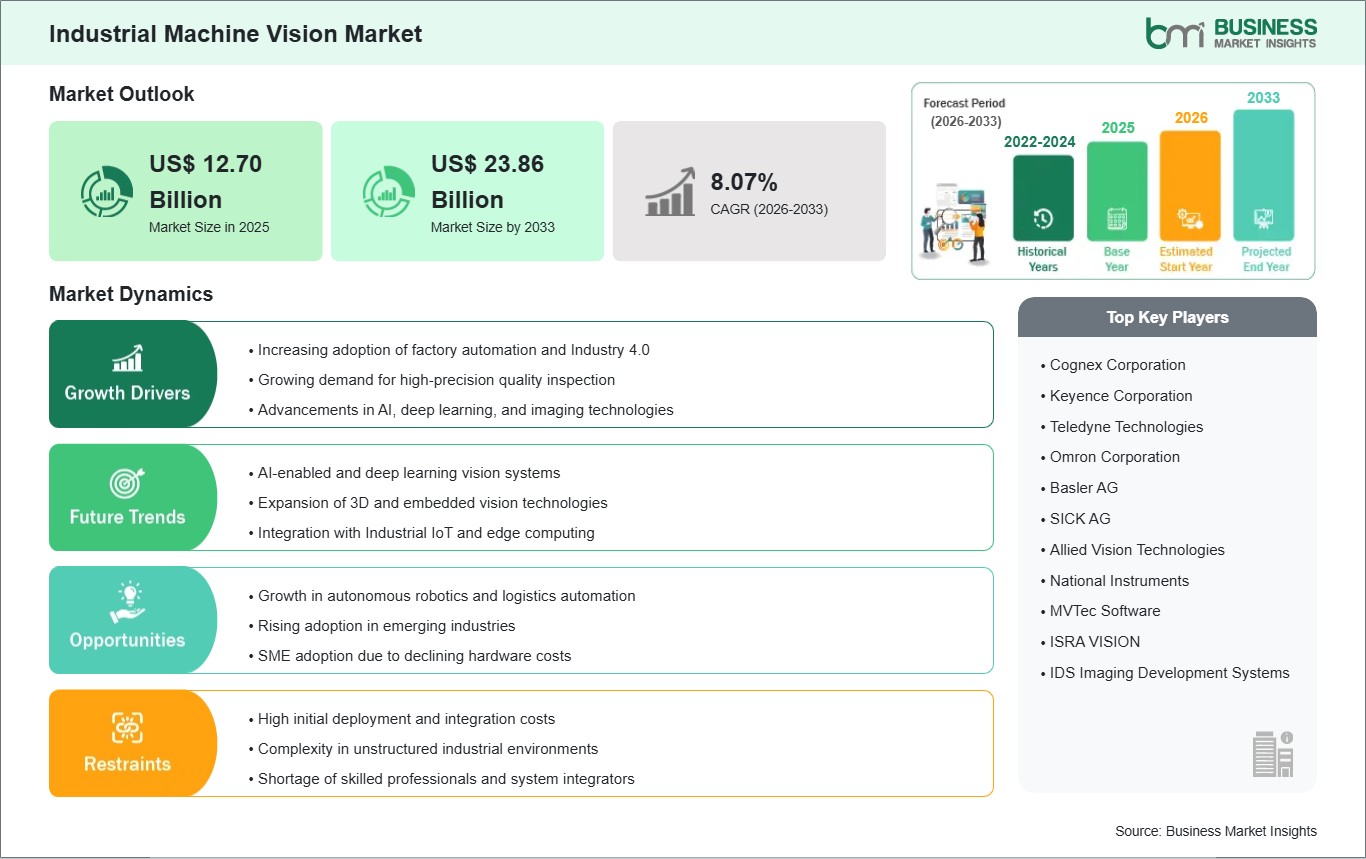
According to Business Market Insights, the global Industrial Machine Vision Market size is expected to reach US$ 23.86 billion by 2033 from US$ 12.70 billion in 2025. The market is estimated to record a CAGR of 8.07% from 2026 to 2033
Recent breakthroughs in embedded vision systems, edge processing chipsets, and deep learning algorithms are radically lowering implementation barriers and expanding system capabilities. Industrial camera vendors and automation solution providers are aggressively rolling out highly integrated smart cameras and multi-camera systems capable of executing hyper-complex metrology, defect detection, and robotic guidance tasks simultaneously under harsh, high-speed factory conditions.
Download Sample Report : https://www.businessmarketinsights.com/sample/BMIPUB00035116
What Is Industrial Machine Vision?
Industrial machine vision refers to the integration of hardware and software components that provide imaging-based automatic inspection and analysis for industrial applications. A complete machine vision architecture typically comprises high-speed digital cameras equipped with specialized industrial optics, optimized illumination sources (such as structured LED lighting), frame grabbers or network interfaces for data transmission, and a processing unit executing specialized image processing software.
Unlike human inspectors, who are subject to fatigue, subjectivity, and physical speed limitations, industrial machine vision systems operate continuously at ultra-high frequencies with absolute consistency. These systems capture precise visual data from moving production lines, analyze features down to microscopic dimensions, and instantly issue pass/fail triggers, precise sorting commands, or robotic coordinates to upstream and downstream automated hardware.
Market Drivers
The foremost driver propelling the Industrial Machine Vision Industry is the global, sweeping implementation of Industry 4.0 and autonomous manufacturing paradigms. Modern factories are moving away from centralized, batch-based quality sampling toward decentralized, 100% in-line product inspection. Machine vision systems serve as the ultimate data collectors in these frameworks, providing the continuous stream of structured visual data required to power edge computing nodes and cloud-based industrial analytics platforms.
The absolute necessity for micro-miniaturization across the electronics and semiconductor sectors is another massive growth catalyst. Components such as multi-layered printed circuit boards (PCBs), microprocessors, and high-density connectors have scaled down to dimensions that are completely impossible for human eyes to inspect. Machine vision systems equipped with ultra-high-resolution sensors and macro optics are mandatory for verifying sub-millimeter solder joints, placing microscopic microchips, and certifying multi-layered semiconductor wafers.
Furthermore, mounting global labor shortages and escalating wage inflations are forcing industrial operators to heavily automate repetitive, manual inspection tasks. Deploying machine vision not only mitigates the risk of human error but also vastly upgrades factory throughput, allowing manufacturing lines to run at maximum mechanical velocities without being bottlenecked by manual inspection speeds.
Additionally, strict track-and-trace mandates across the pharmaceutical, medical device, and food and beverage sectors are compelling manufacturers to adopt machine vision. Systems equipped with advanced optical character recognition (OCR) and barcode reading capabilities ensure that serialization data, expiration dates, and tracking codes are perfectly printed and logged across every single package, directly preventing expensive product recalls and regulatory penalties.
Get More Details : https://www.businessmarketinsights.com/buy/BMIPUB00035116
Market Segmentation
By Component
- Hardware (Cameras, Optics/Lenses, Illuminations, Processors & Frame Grabbers)
- Software (Traditional Algorithmic Software, Deep Learning/AI Software)
By Product Type
- PC-Based Machine Vision Systems
- Smart Camera-Based Machine Vision Systems
By Application / Vertical
- Automotive
- Semiconductor & Electronics
- Pharmaceuticals & Healthcare
- Food & Beverages
- Logistics & Warehouse Automation
- Packaging & Printing
The PC-based systems segment commands a significant share of market revenue due to its unparalleled processing power, which is vital for multi-camera configurations and highly intensive 3D scanning algorithms. Concurrently, the smart camera segment is registering the fastest growth rate owing to its highly compact footprint, ease of installation, and cost-effective pricing structure. From a vertical standpoint, the semiconductor and electronics industry historically drives massive volume demand, while logistics is expanding rapidly due to the e-commerce automation boom.
Regional Insights
- Asia-Pacific represents the largest and most dynamic regional market for industrial machine vision globally. This absolute dominance is driven by the dense concentration of electronic component manufacturing facilities, massive automotive assembly plants, and rapid, state-subsidized factory automation programs across China, Japan, Taiwan, and South Korea.
- North America holds a highly mature, high-value market position, heavily anchored by intensive investments in aerospace engineering, advanced automotive manufacturing, and a massive boom in automated fulfillment centers relying on vision-guided logistics robots across the United States.
- Europe commands a powerful market share, strongly underpinned by the region’s world-leading automotive manufacturing base (especially in Germany) and stringent European Union regulations governing product safety and quality assurance in pharmaceuticals and medical devices.
- Middle East & Africa and South & Central America are demonstrating steady, strategic progress as regional manufacturers gradually transition from legacy manual production methodologies to modern, automated packaging and processing lines to stay globally competitive.
Top Players in the Industrial Machine Vision Industry
The global marketplace features intense competition among dedicated machine vision pioneers, metrology specialists, and broad industrial automation giants. Key industry participants place heavy emphasis on designing proprietary sensor architectures, expanding open-source software integration, and developing edge-based artificial intelligence capabilities.
- Cognex Corporation
- Keyence Corporation
- Omron Corporation
- Basler AG
- Teledyne Technologies Inc.
- National Instruments (Emerson Electric)
- TKH Group N.V.
- Sony Corporation
- Banner Engineering Corp.
- Baumer Holding AG
These market leaders continuously acquire specialized software developers and form close partnerships with robotic system integrators to deliver end-to-end, pre-configured vision packages directly to end users.
Technological Innovations
Technological innovations in 3D Machine Vision are fundamentally upgrading industrial capabilities. Traditional 2D vision systems can struggle with varying lighting conditions and cannot measure depth, height, or volumetric data. Next-generation 3D vision systemsutilizing laser profiling, time-of-flight (ToF) sensors, and stereo visioncreate hyper-accurate 3D point clouds of parts. This breakthrough is critical for automated bin-picking, complex surface inspection, and verifying the exact volumetric distribution of adhesives or weld beads.
Furthermore, the integration of Artificial Intelligence (AI) and Deep Learning into vision software is revolutionizing defect detection. Traditional software relies on rule-based programming, which can fail when inspecting organic, highly variable items like agricultural products or cast metals with minor cosmetic variances. Deep learning algorithms ingest thousands of sample images to understand what a good part looks like, allowing the system to instantly identify unpredictable anomalies and surface scratches while virtually eliminating false rejects.
Additionally, the commercialization of Hyperspectral and Short-Wave Infrared (SWIR) imaging is gaining massive traction. These specialized cameras capture wavelengths of light far outside the visible spectrum. This allows machine vision systems to literally see through plastic packaging to check fill levels, detect hidden internal bruising in agricultural sorting lines, and identify exact material composition anomalies on high-speed recycling conveyors.
Future Market Outlook
The long-term trajectory for the Industrial Machine Vision Industry remains exceptionally robust and highly lucrative. As global manufacturing scales up its reliance on collaborative robots (cobots) and autonomous mobile robots (AMRs), the demand for compact, low-power embedded vision sensors to provide safe, real-time navigational awareness will reach unprecedented heights.
The upcoming maturation of 5G-enabled edge-to-cloud architectures will allow factory managers to seamlessly link multiple disparate machine vision systems together into a single, unified plant network. This will enable predictive manufacturing frameworks where a defect detected by a vision system on a packaging line can instantly trigger automatic adjustments to a CNC machine or injection molding press upstream. Companies that continuously pioneer advanced optical designs, deliver open AI software ecosystems, and minimize processing latency will maintain a commanding lead in the global industrial quality framework.
Frequently Asked Questions (FAQs)
What is the primary difference between a Smart Camera and a PC-Based vision system?
A smart camera is an all-in-one device containing the image sensor, processor, and software within a single compact housing, making it highly cost-effective and easy to deploy for single-point inspections. A PC-based system utilizes separate, high-performance cameras connected to a powerful industrial computer, which is necessary for processing complex 3D scans or managing data from multiple cameras simultaneously.
How does Deep Learning improve industrial machine vision?
Traditional vision systems use strict, rule-based math to find defects, which fails when parts have natural variations (like wood grain or fabric patterns). Deep learning software trains on images of acceptable parts, learning to tolerate natural, benign variations while instantly spotting true, unpredictable defects like micro-cracks or structural deformities without requiring complex manual programming.
Can machine vision operate effectively in harsh factory environments?
Yes. Industrial cameras and lenses are specifically engineered for heavy manufacturing, featuring ruggedized enclosures rated up to IP67 or IP69K. This ensures complete protection against intense vibrations, fine industrial dust, chemical washdowns, and extreme temperature fluctuations that would instantly destroy commercial-grade electronics.
Why is 3D vision becoming highly popular in logistics and robotics?
Traditional 2D vision only detects flat, X-Y coordinates, which is insufficient for picking randomly stacked items out of a deep bin. 3D machine vision provides critical Z-axis depth data, allowing robotic arms to accurately calculate the orientation, height, and gripping angle of asymmetrical items without colliding with the walls of the storage bin.
Browse More Reports:
https://www.businessmarketinsights.com/reports/africa-web-content-management-market
https://www.businessmarketinsights.com/reports/asia-pacific-web-content-management-market
https://www.businessmarketinsights.com/reports/bric-cancer-therapeutics-market
About Us
Business Market Insights is a market research platform that provides a subscription service for industry and company reports. Our research team has extensive professional expertise in domains such as Electronics & Semiconductor; Aerospace & Defense; Automotive & Transportation; Energy & Power; Healthcare; Manufacturing & Construction; Food & Beverages; Chemicals & Materials; and Technology, Media, & Telecommunications.
Contact Us
If you have any questions about this report or would like further information, please contact us:
Contact person: Ankit Mathur
Email: sales@businessmarketinsights.com
Phone: +16467917070″