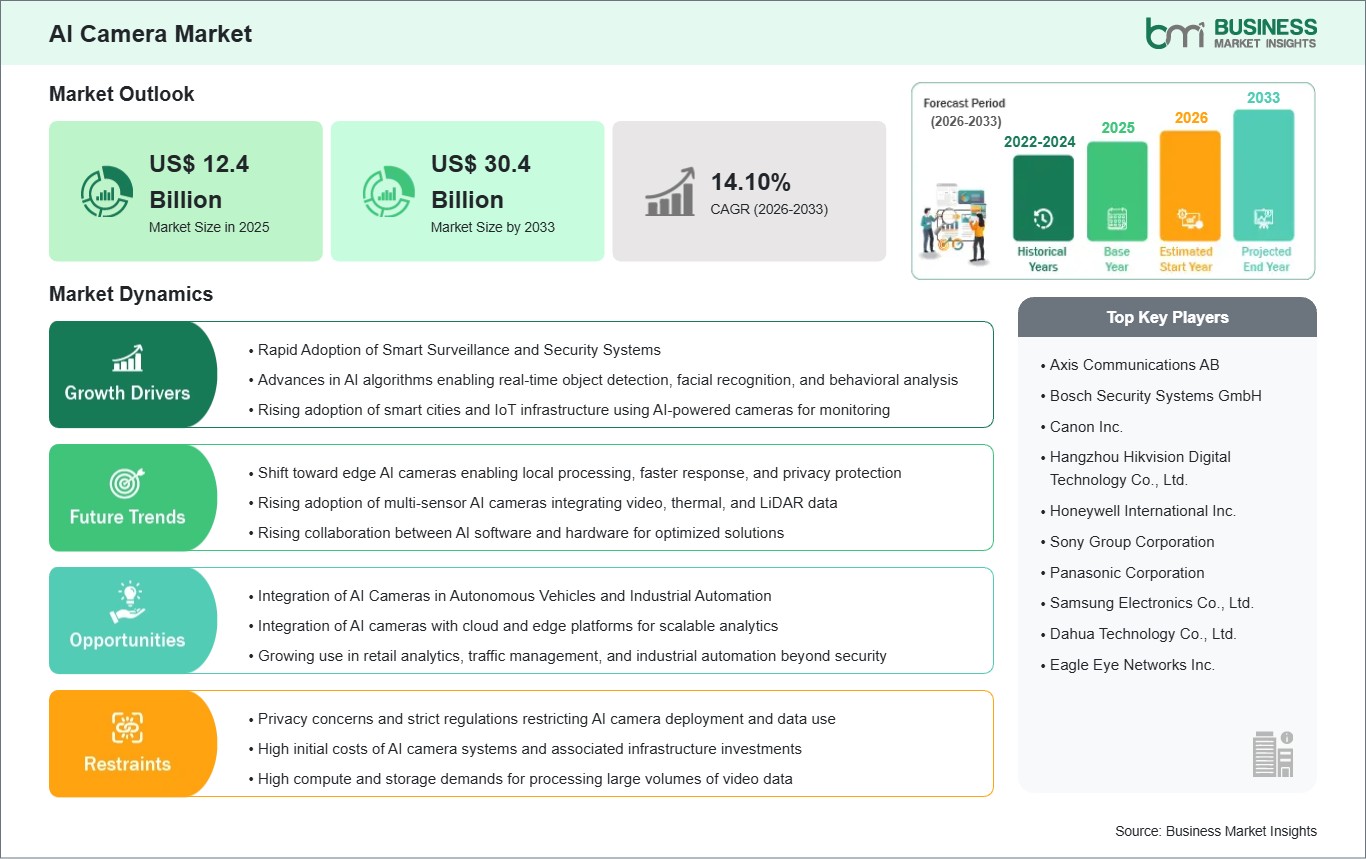
The global AI Camera Industry is experiencing a monumental technological transformation, shifting from passive imaging devices into autonomous computational systems capable of edge-based visual intelligence. AI cameras integrate specialized hardware such as Neural Processing Units (NPUs), deep-learning accelerators, and advanced image signal processors (ISPs) with computer vision algorithms to perform real-time object detection, facial recognition, behavioral analysis, and semantic scene segmentation.
According to Business Market Insights, the global AI Camera Market size is expected to reach US$ 30.4 Billion by 2033 from US$ 12.4 Billion in 2025. The market is estimated to record a CAGR of 11.86% from 2026 to 2033.
Advancements in custom system-on-chip (SoC) microarchitectures, low-power edge processing, generative AI image enhancement, and multi-sensor data fusion are rapidly reshaping the competitive landscape. Leading semiconductor manufacturers and optical engineering companies are investing heavily in reducing latency, enhancing low-light performance, and securing data privacy through on-device edge anonymization. These strategic research and development initiatives are designed to bypass the bandwidth constraints and security vulnerabilities of cloud-dependent post-processing, enabling high-speed, localized decision-making that complies with global privacy mandates.
What Are AI Cameras?
AI cameras are advanced visual capture systems that combine optical sensors with onboard artificial intelligence and machine learning frameworks to interpret visual data at the point of ingestion. Moving beyond traditional cameras that merely record light onto a digital sensor, AI-enabled cameras analyze the content of the frame continuously. This architecture allows the device to not only capture images but also understand spatial contexts, identify specific objects, track motion vectors, and execute complex analytics without relying on external servers or cloud computing pools.
These advanced digital configurations operate by passing raw image data through deep neural networks trained on massive visual datasets. On the hardware level, dedicated hardware accelerators process billions of operations per second with minimal power consumption, making them highly efficient for edge deployments. In surveillance setups, this allows for immediate boundary violation alerts and anomaly detection. In consumer devices, it enables real-time computational photography, where software dynamically adjusts depth of field, reduces multi-frame noise, and optimizes exposure configurations tailored to the unique subjects within the frame.
Download Sample Report: https://www.businessmarketinsights.com/sample/BMIPUB00033244
Market Drivers
A primary driver accelerating the global AI Camera Industry is the Widespread Integration of Computational Photography in Flagship Smartphones and Consumer Electronics. Consumer expectations for mobile photography have surpassed the physical limits of small camera lenses and mobile sensors. Smartphone manufacturers overcome these constraints by embedding AI-driven software layers that instantly synthesize multiple exposures, map realistic portrait blurs, optimize low-light environments, and perform real-time semantic facial touch-ups. The fierce competition among device OEMs to deliver professional-tier media capabilities inside standard consumer hardware guarantees a massive, high-volume baseline demand for intelligent imaging chips.
The accelerating deployment of Proactive Smart Surveillance Infrastructure in Smart Cities and Commercial Real Estate serves as another core driver. Municipalities and corporate enterprises are rapidly upgrading legacy analog setups to autonomous security grids capable of behavioral mapping, crowd density metrics, automated license plate recognition (ALPR), and weapon detection. Unlike reactive recording systems that only provide evidence after an event, AI cameras assess active situations and trigger immediate preventative alerts, significantly optimizing public safety budgets and corporate loss-prevention workflows.
Additionally, the massive expansion of the Global Creator Economy and Digital Entertainment Ecosystems acts as a vital market catalyst. Independent content creators, vloggers, and livestreamers require professional-grade production values without the overhead of multi-person camera crews. AI cameras fulfill this operational need by introducing intelligent auto-framing, real-time subject tracking, active acoustic focusing, and automated lighting adjustments. These built-in features allow individual creators to stream and capture cinematic content seamlessly, driving substantial volume growth across standalone cameras, action cameras, and specialized gimbal integrations.
Market Segmentation
By Product Type
- Smartphone Cameras (Commanding a massive volume and revenue share due to rapid product refresh cycles, consumer demand for advanced imaging features, and aggressive NPU integration by major mobile OEMs)
- Surveillance Cameras (Securing a dominant footprint across commercial retail, public infrastructure, and defense sectors for real-time edge analytics, perimeter protection, and automated access control)
- DSLRs and Standalone Systems (Maintaining a high-value niche among professional studios, sports broadcasters, and wildlife photographers who rely on predictive neural focus tracking and high-speed matrix adjustments)
By Technology Matrix
- Computer Vision & Deep Learning (The leading technology segment, serving as the foundational layer that enables spatial mapping, semantic segmentation, and localized object tracking)
- Image and Face Recognition (Exhibiting extensive penetration within smart retail, workplace attendance management, and biometric security systems to automate verification processes safely)
- Speech and Voice Recognition (Tracking steady growth as consumer and smart-home security systems implement multi-modal interfaces for hands-free configuration and contextual recording triggers)
By End-Use Industry
- Consumer Electronics (The premier revenue generator by volume, fueled by continuous global adoption of AI-enhanced smartphones, smart home doorbells, and action cameras)
- Commercial & Enterprise Retail (Deploying intelligent vision arrays to execute contact-free checkouts, evaluate customer foot-traffic heatmaps, and automate loss-prevention strategies)
- Government & Public Infrastructure (Allocating large municipal budgets for smart city monitoring, automated traffic management systems, and border security installations)
- Automotive & Transportation (Integrating high-speed vision arrays for advanced driver assistance systems (ADAS), cabin driver-fatigue monitoring, and autonomous vehicle navigation pathways)
Get More Insights: https://www.businessmarketinsights.com/buy/BMIPUB00033244
Regional Insights
- North America holds the premier position in the global market landscape, securing a dominant market share of approximately 40% in 2025. This leadership is anchored by massive R&D allocations, the presence of major cloud and AI platform pioneers, and immediate enterprise-wide rollouts of smart retail and corporate loss-prevention networks across the United States.
- Asia-Pacific represents the fastest-growing geographical segment, projected to maintain its explosive forward momentum through 2034. This rapid scaling is propelled by dense electronics manufacturing hubs in China, Japan, and South Korea, wide-reaching public smart-city initiatives, and a massive consumer base migrating rapidly toward premium, AI-enabled smartphones.
- Europe exhibits a highly structured, substantial market footprint, heavily supported by strict automotive driver-monitoring safety mandates and extensive integration of advanced vision systems within German, French, and UK industrial automation networks (Industry 4.0).
- Rest of the World is displaying steady, progressive growth patterns, driven by ongoing modernization projects in Middle Eastern smart cities and localized implementations of smart security networks at critical transportation hubs across Latin America and Africa.
Top Players in the Industry
The competitive ecosystem displays a sophisticated matrix of semiconductor leaders, consumer tech giants, and specialized surveillance innovators focusing on vertical integration, edge silicon optimization, and recurring software-as-a-service (SaaS) visual analytics platforms.
- Sony Corporation
- Bosch Security Systems
- Axis Communications AB
- Apple Inc.
- Google LLC
- NVIDIA Corporation
- Samsung Electronics Co., Ltd.
- Intel Corporation
- Panasonic Holdings Corporation
- Canon Inc.
Technological Innovations
The commercial implementation of advanced On-Chip Generative Neural Processing and Transformer-Based Vision Networks represents a monumental structural breakthrough for the AI camera sector. Historically, edge devices were limited to basic pattern recognition, relying on the cloud for complex contextual scene reconstruction. Next-generation camera SoCs incorporate native transformer models that analyze the relationship between pixels across the entire frame simultaneously. This architecture allows the camera to predict lighting changes, accurately reconstruct heavily occluded objects, and synthetically eliminate extreme motion blur on-device in milliseconds, setting new performance standards for automotive safety and action photography alike.
Concurrently, the transition toward Ethical Privacy Shields and Decentralized Edge Anonymization Layers is completely modernizing the industrial and retail surveillance landscape. To comply with evolving global data protection frameworks like GDPR and CCPA, camera manufacturers are building privacy protection directly into the hardware firmware. Modern AI cameras can isolate and structurally encrypt or blur human faces and unique license plates right at the sensor level before any visual data is saved to disk or transmitted across network lines. This ensures compliance with privacy mandates while allowing the device to extract non-identifying operational analytics, such as foot-traffic counts and vector velocities.
Future Market Outlook
The long-term trajectory for the AI Camera Market remains exceptionally robust. As multi-modal AI frameworks continue to mature, combining visual ingestion with acoustic and environmental sensors, and global enterprise operations commit permanently to autonomous digital workflows, the universal reliance on intelligent edge imaging systems will grow continuously, establishing baseline parameters across advanced technology sciences.
Future research and development capital will be heavily directed toward the commercialization of ultra-low-power neuromorphic sensors that mimic human optical nerves, the refinement of multi-spectral AI cameras for agricultural and medical diagnostics, and the creation of unified cross-platform operating systems designed for plug-and-play smart city integrations. Technology developers that successfully pair advanced analytical performance with hardware-level privacy protection will comfortably secure long-term global market leadership.
Frequently Asked Questions (FAQs)
What is the projected valuation of the global AI camera market by 2034?
The global market is projected to reach an estimated valuation of US$ 103.76 Billion by 2034, expanding significantly from its established baseline valuation of approximately US$ 17.76 Billion in 2025.
What is the expected compound annual growth rate (CAGR) of the market over the forecast window?
The market is anticipated to expand at a powerful Compound Annual Growth Rate (CAGR) of 21.67% globally during the target forecast timeline spanning from 2026 through 2034.
How do AI cameras maintain compliance with international data privacy regulations like GDPR?
Modern AI cameras feature on-device edge anonymization layers that automatically encrypt or blur personally identifiable information (PII), such as human facial features or license plates, right at the hardware sensor layer before any data is stored or transmitted.
Why is the smartphone segment leading in terms of market volume?
Smartphones lead volume shares due to intense consumer demand for advanced computational photography, continuous product refresh cycles by global OEMs, and the universal adoption of onboard Neural Processing Units (NPUs) to execute complex visual filters in real time.
Browse More Reports:
Africa 3D and 4D technology Market
GCC 3D and 4D Technology Market
About Us
Business Market Insights is a market research platform that provides subscription service for industry and company reports. Our research team has extensive professional expertise in domains such as Electronics & Semiconductor; Aerospace & Defense; Automotive & Transportation; Energy & Power; Healthcare; Manufacturing & Construction; Food & Beverages; Chemicals & Materials; and Technology, Media, & Telecommunications.
Contact Us
If you have any questions about this report or would like further information, please contact us:
Contact person: Ankit Mathur
Email: sales@businessmarketinsights.com
Phone: +16467917070